
Some mornings, one of our customers sends us a photo of their robot. Not because something is wrong, but because it has been running all night. Again.
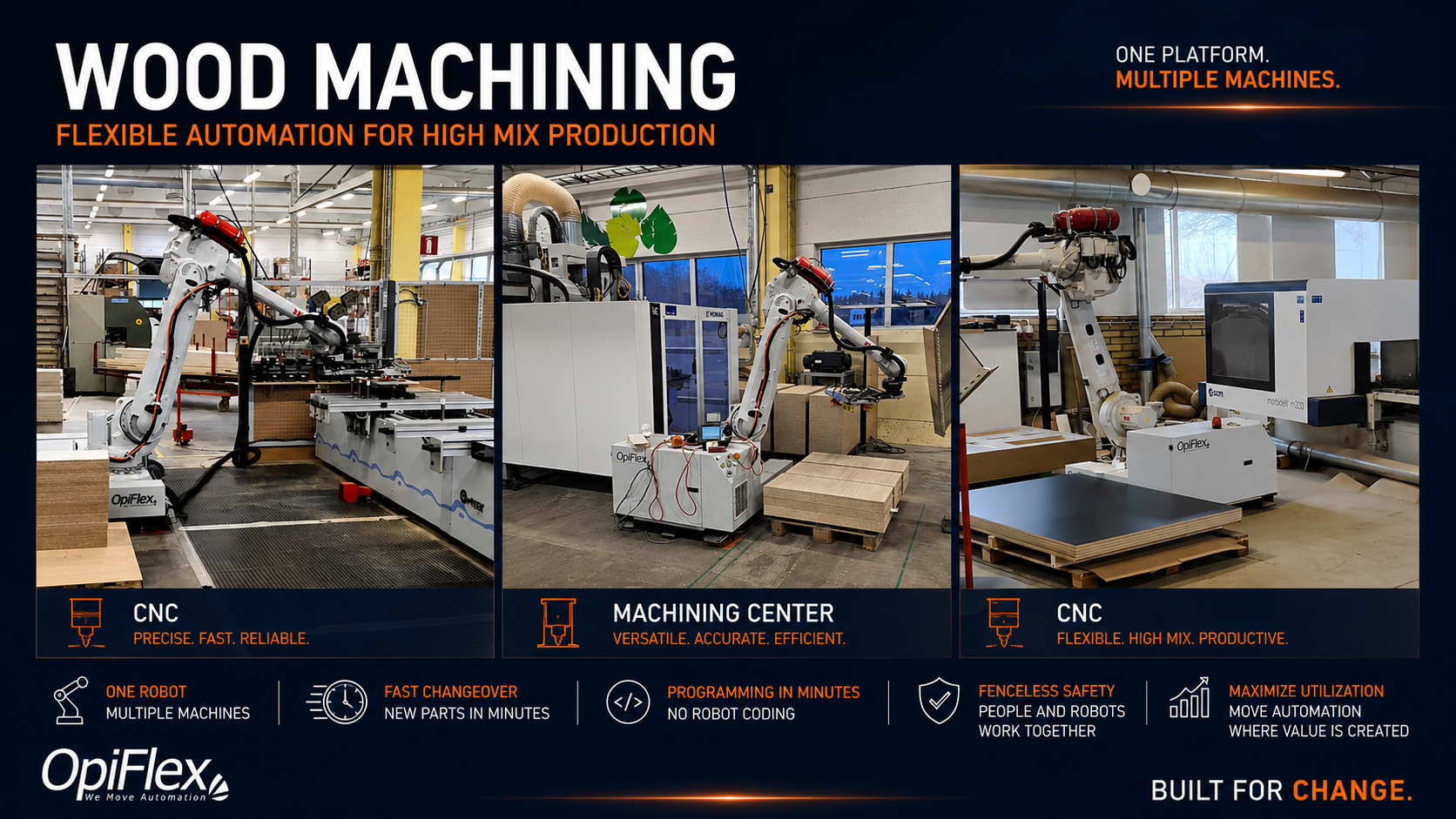
The customer is a small subcontractor in the wood industry. Every year, each machine gets around 4,000 new product variants. For most robot solutions, that would be far too many to program. For them, it is a normal year.
Short series by day, long runs by night
In the morning, they run short series with operators nearby. In the evening and at weekends, the robot takes the longer runs on its own. The robot cell is mobile and is moved between machines when the order book changes.
New parts are added by the operator in 1–3 minutes with the Dynamic Program Generator, without robot skills, down to batch size one. That is what makes 4,000 new variants a year possible.
What it gives
The customer has freed up around 1.5 operators per shift. In wood, a mobile robot normally corresponds to 1.5–1.6 people per shift, because it moves to the next machine instead of waiting when one machine runs out of work. The extra hours at night and at weekends are, in practice, free extra shifts.
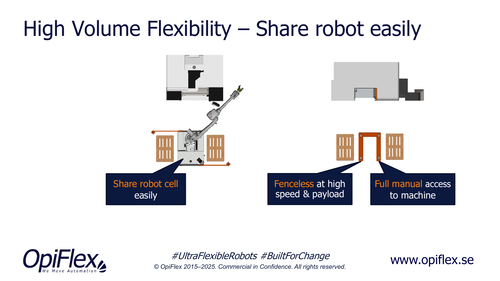
Because the cell has no fence, the operators keep full manual access to the machine. Moving the cell to another machine takes 2–4 hours.
Not a one-off
In 2019, OpiFlex received an innovation award at Puumessut, Finland's largest wood fair, together with the wood machine maker SCM and its distributor Innomac. The Swedish Agency for Economic and Regional Growth and Träcentrum have made a film about flexible automation in the wood industry with OpiFlex.
Your production
Tell us which machines and steps you still run by hand, and we will take 30 minutes on Teams to see if a mobile robot fits. Contact us.
Related articles
-

Real-time robot adjustment from ERP and quality | OpiFlex
Orders from ERP, quality results and sensor data change the robot's active program in real time, with full traceability of every part. How it works.
Read more -
Mobile, fixed or collaborative robots, one software | OpiFlex
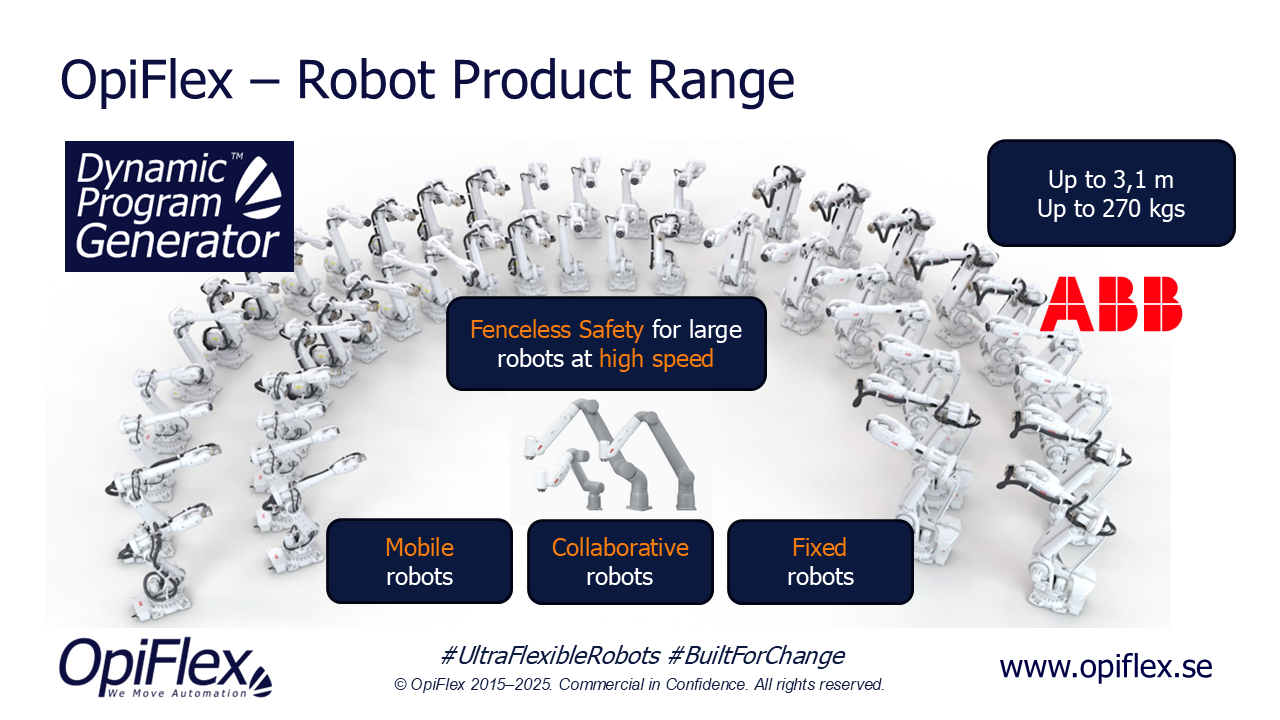
OpiFlex offers mobile, fixed and collaborative ABB robots with the same Dynamic Program Generator and fenceless safety. Choose the robot for your production.
Read more -
One robot, several CNC machines: machine tending | OpiFlex
When one robot moves between several CNC machines, small batches and night shifts start to pay. How machine shops use a mobile robot cell, with a real case.
Read more