.png)
Press brake robot without fences or a raised press | OpiFlex
In many sheet metal shops the press brake is the bottleneck. The parts are many, the batches are short, and it is hard to find operators for the second shift. A robot can help, but the press brake also needs to stay available for the jobs that are best done by hand.
The press stays at normal height
When a press brake is robotised, it is common to raise it 500–700 mm to suit the robot. We keep the press brake at its normal working height. Your operators can step in and run it manually whenever they want, for a one-off part, a prototype or a quality check.
No fence, also for large robots
OpiFlex has a patented fenceless safety solution for large robots at high speed. The robot and the operator never share the working area at the same time. People, robot, platform, gripper and parts are monitored to EN ISO 10218-2, PLd Category 3, in line with the EU Machinery Directive 2006/42/EC. The grippers are designed not to drop the part if air or power is lost.
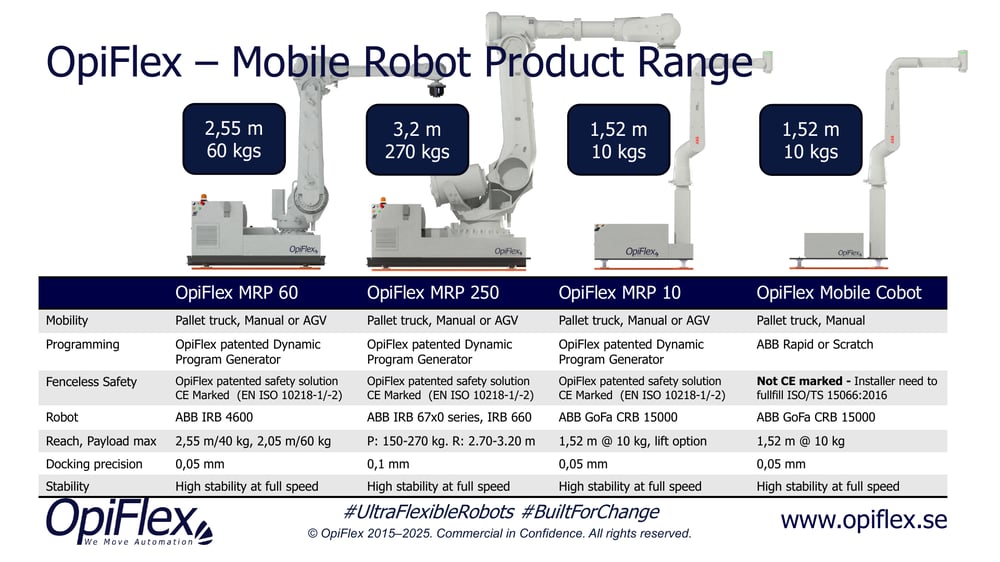
For heavy and large parts, the cell can be built on ABB robots with up to 60 kg or 150–270 kg payload.
One robot for the press brake, the panel bender and the press
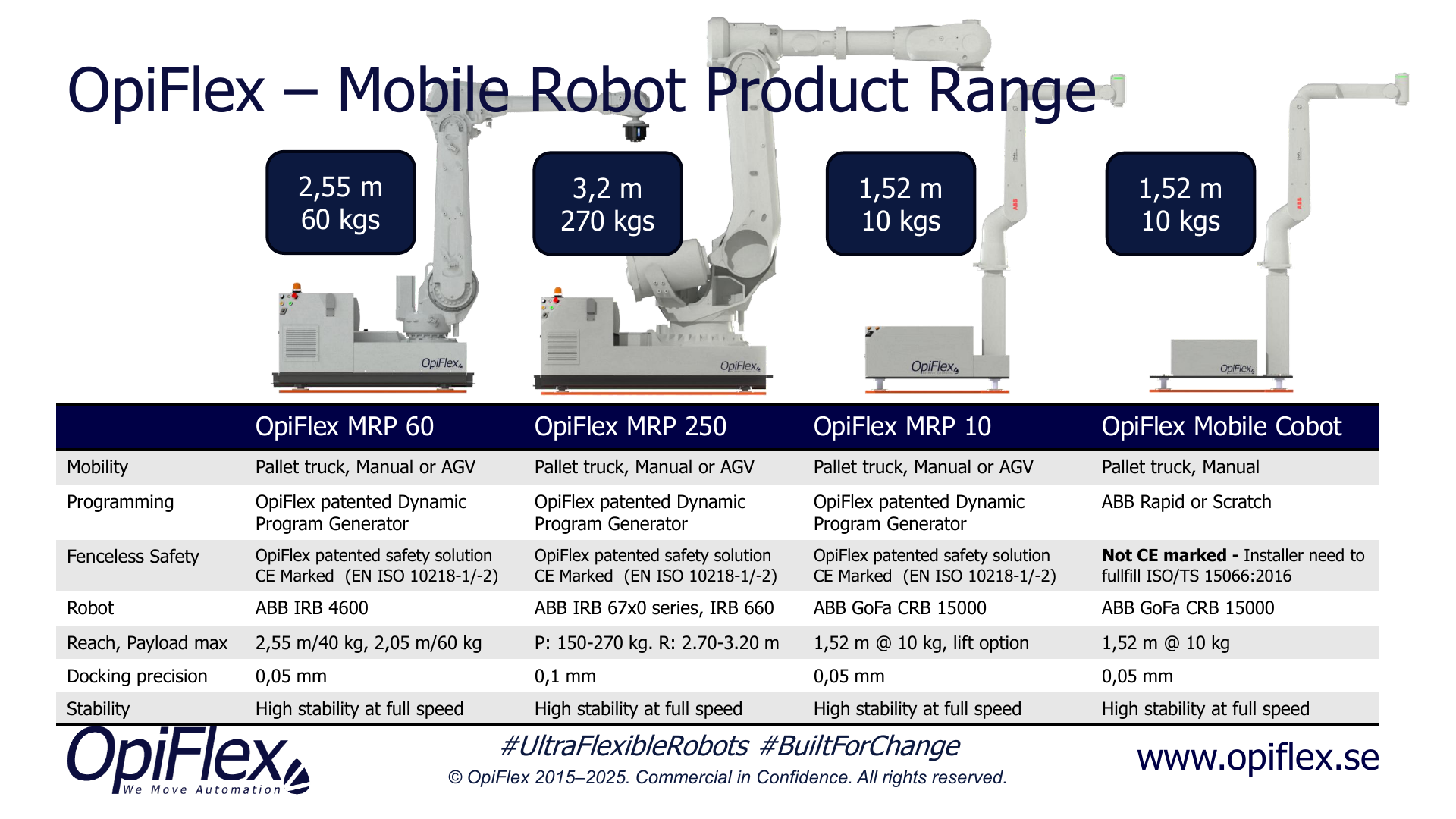
The cell is mobile. It is moved with a pallet truck, manually or by AGV, and docks with high precision. When the press brake order is done, the same robot can serve a panel bender or a hydraulic press. New parts are added by the operator in 1–3 minutes with the Dynamic Program Generator, without robot skills.
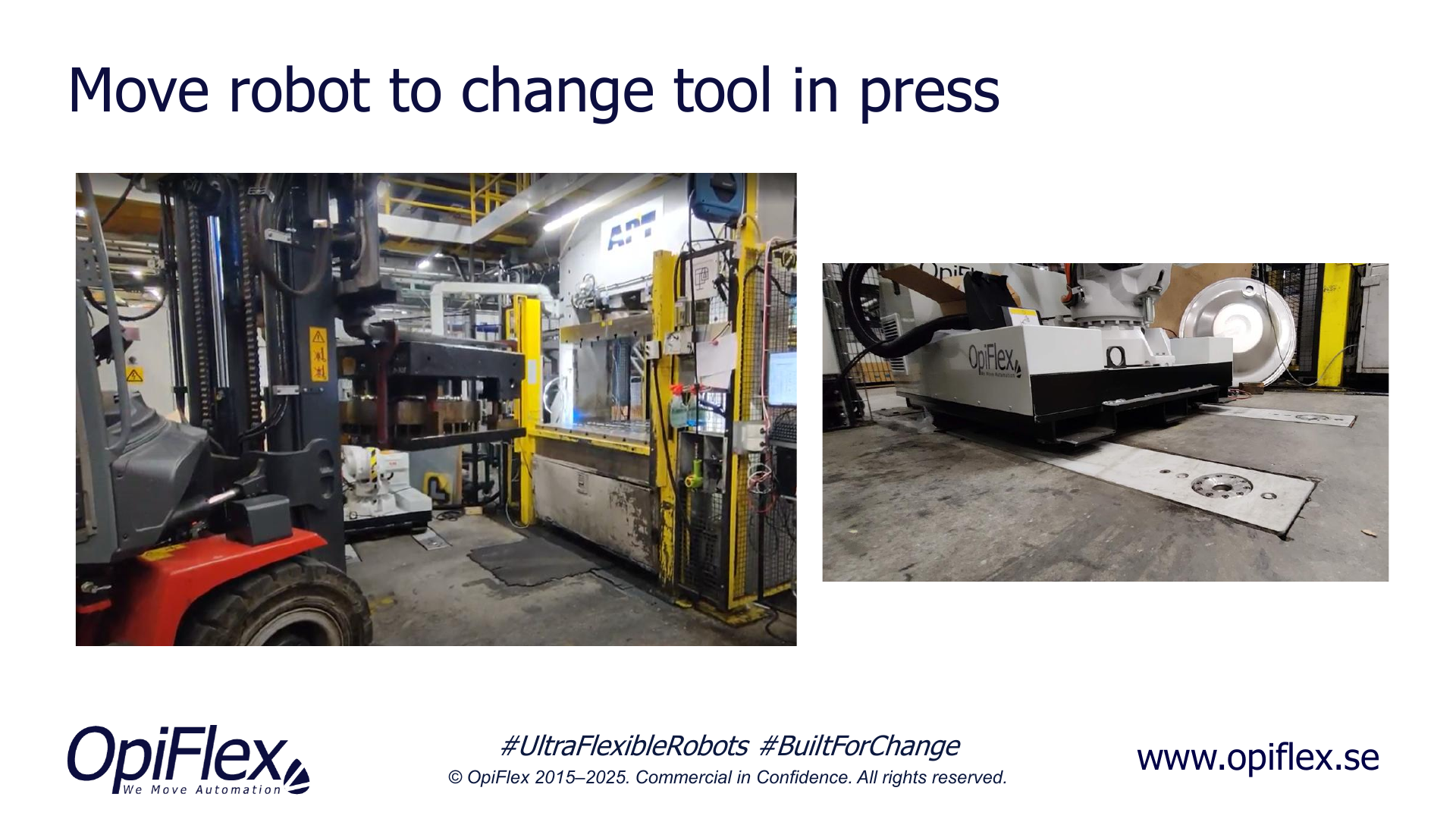
Because the robot moves to where the work is, a mobile robot in sheet metal typically corresponds to 1.2–1.5 people per shift, compared with normally one person for a fixed robot.
In one SME case, a single robot serves a CNC machine, a panel bender and a press brake. At the press brake alone, productivity rose by 22 % and 1.2 operators moved to other work.
From one press brake to three cells
A contract manufacturer in western Sweden contacted us to automate one press brake. They were recommended to us by their machine supplier. It ended with three cells: the press brake, a lathe and a turn-mill.
In January 2022, The FABRICATOR, North America's leading magazine for metal forming and fabrication, put flexible mobile robots for press brakes and panel benders on its cover.
Your parts, your numbers
Send us a few pictures of typical parts from your press brake and we will take 30 minutes on Teams to look at how they could run in a robot. Contact us.
Related articles
-
Standardised flexible robot cells for OEM, Tier 1 | OpiFlex
More variants, new lines, 3–5 shifts. How OEMs and Tier 1 suppliers get flexible robot cells that are standardised, quick to install and easy to maintain.
Read more -
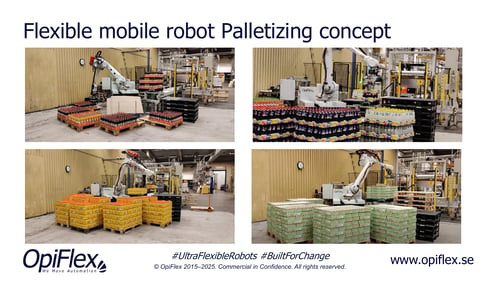
Seasonal palletising with a mobile robot cell | OpiFlex
Peak before Christmas, quiet in spring. How a mobile, fenceless palletising cell follows the season, builds mixed and display pallets, and moves between lines.
Read more -

10 Years of Disruption: How OpiFlex Redefined Flexible Robotics in Manufacturing
Discover how OpiFlex transformed robot automation with ultra-flexibility and smart programming—10 years after winning the EU's top innovation award.
Read more