.png)
A fence is a reliable way to keep people and a large robot apart. It is also bolted to the floor. When the robot is meant to move to the next machine tomorrow, the safety has to be able to move with it.
Two ways to work without a fence
Collaborative robots are designed to work close to people. For many light tasks that is the right choice, and our own range includes cobots too.
A large robot at full speed with a heavy part needs another principle. OpiFlex Dynamic Fenceless Safety is built on a simple rule: the person and the robot never use the working area at the same time. Around the robot there is a warning zone, a low-speed zone and a stop zone. Both the zones and the sensor positions adapt dynamically.
What is monitored
People, robot, platform, gripper and parts are monitored by a safety system to EN ISO 10218-2, PLd Category 3, in line with the EU Machinery Directive 2006/42/EC, Annex II 1.A. The cells are CE marked to EN ISO 10218-1 and -2. The grippers are designed not to drop the part if air or power is lost.
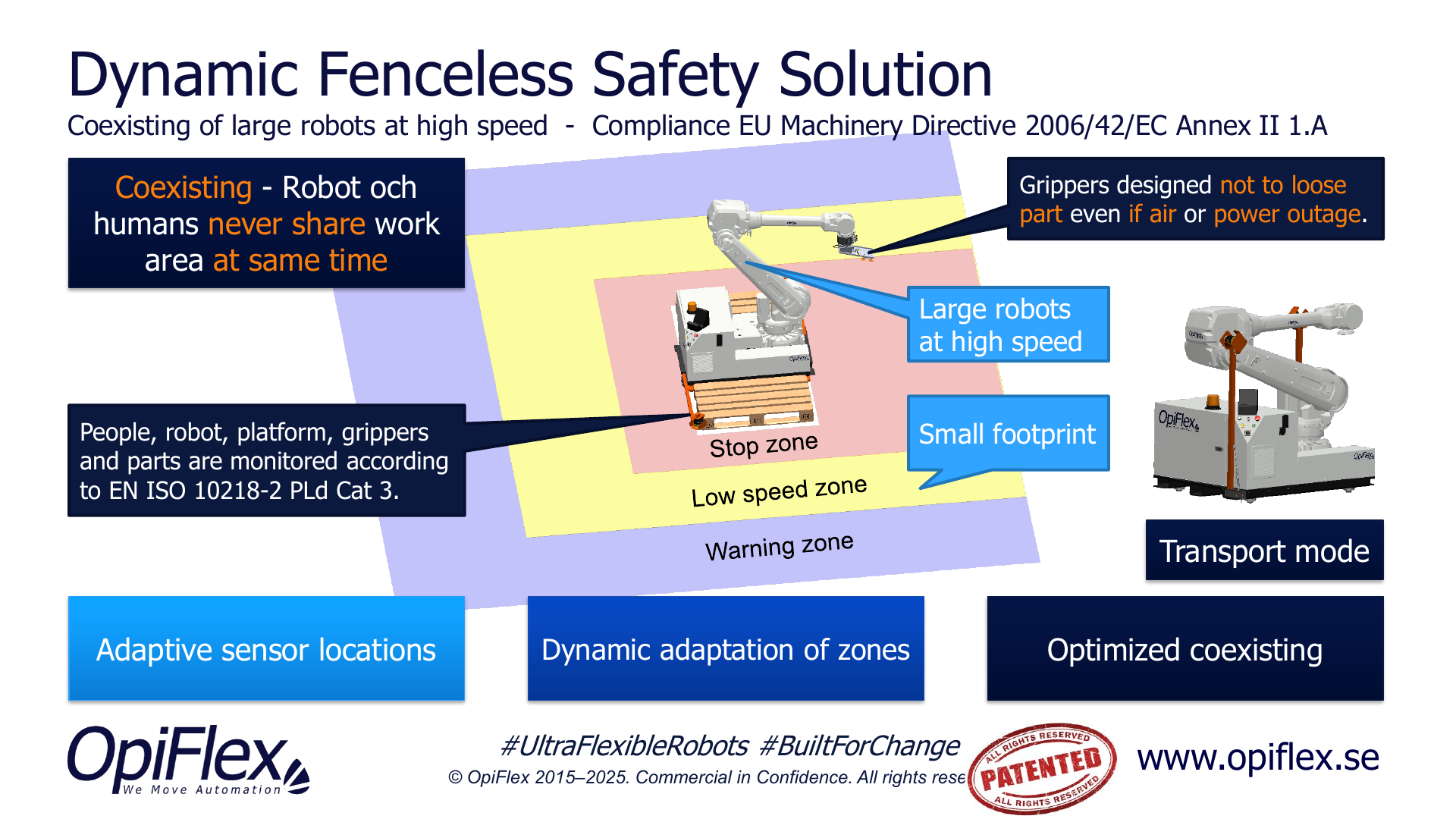
The solution is patented. SICK has made films about it and featured OpiFlex as one of four success stories.
What it changes on the floor
Without a fence around the cell, the robot needs less floor space. The operator keeps full manual access to the machine, for a one-off part, a prototype or a quality check.
The layout can also change. In our comparison, moving a cell takes 2–4 hours, against 1.5–2 weeks for a fixed cell with a fence. That is what makes it realistic to share one robot between several machines, or to move it to a new line when production changes.
When a fence is still the better answer
Some high-volume stations run the same thing all day, and there you may prefer a physical barrier. A mobile fence monitored by a scanner can be added at that station, and removed again when the station changes.
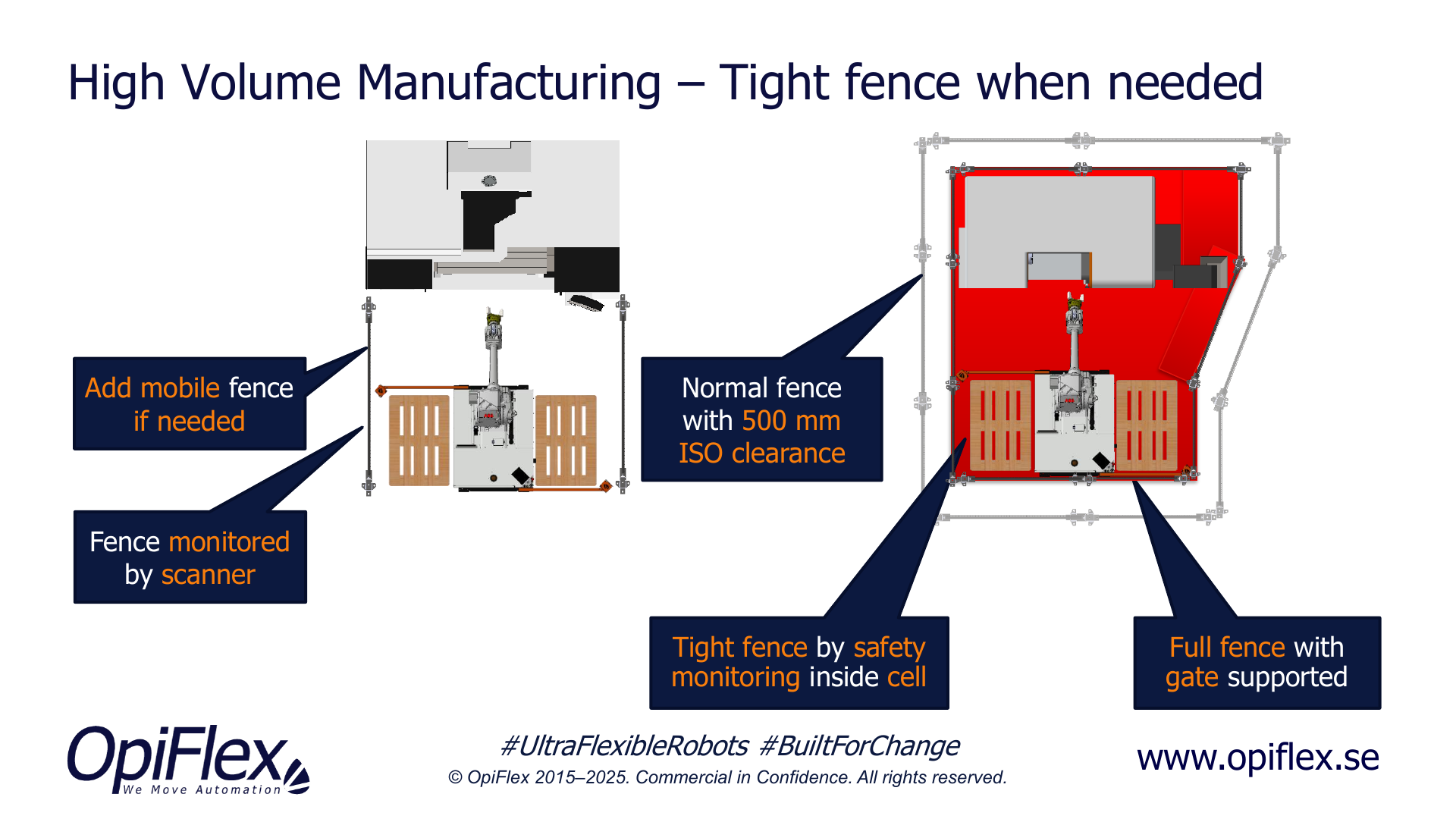
Scania has accepted our fenceless safety solution.
Questions from your safety team
Safety questions are best answered for a specific station. If you send us a few pictures of the machine and the area around it, we can go through the concept with your HSE team or safety representative and hear what they need to see. Get in touch here.
Related articles
-
Sustainable automation: reuse robots | OpiFlex
Three lines at 32, 24 and 26 % utilisation, one shared mobile robot at 82 %. An example of how standardised, mobile robots get more hours and are reused.
Read more -
Mobile, fixed or collaborative: choosing the right robot
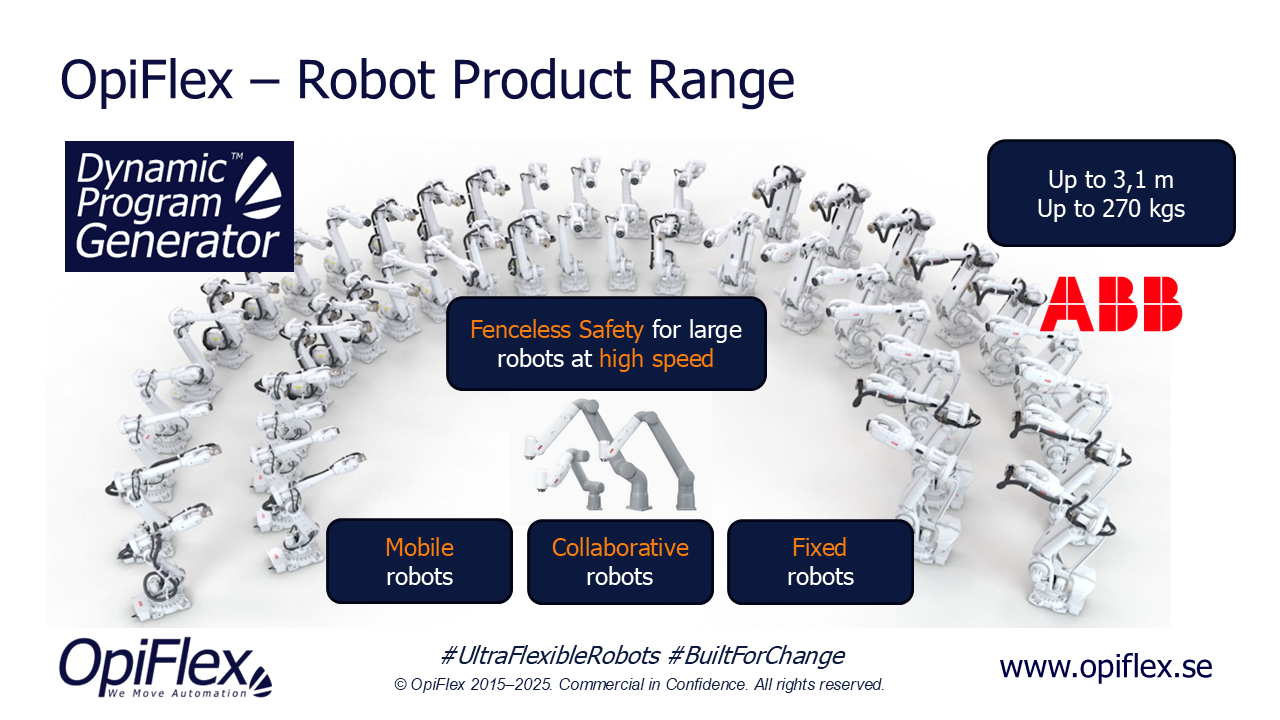
When to choose a mobile, fixed or collaborative ABB robot from OpiFlex, by payload and reach, and which ones come with the Dynamic Program Generator.
Read more -
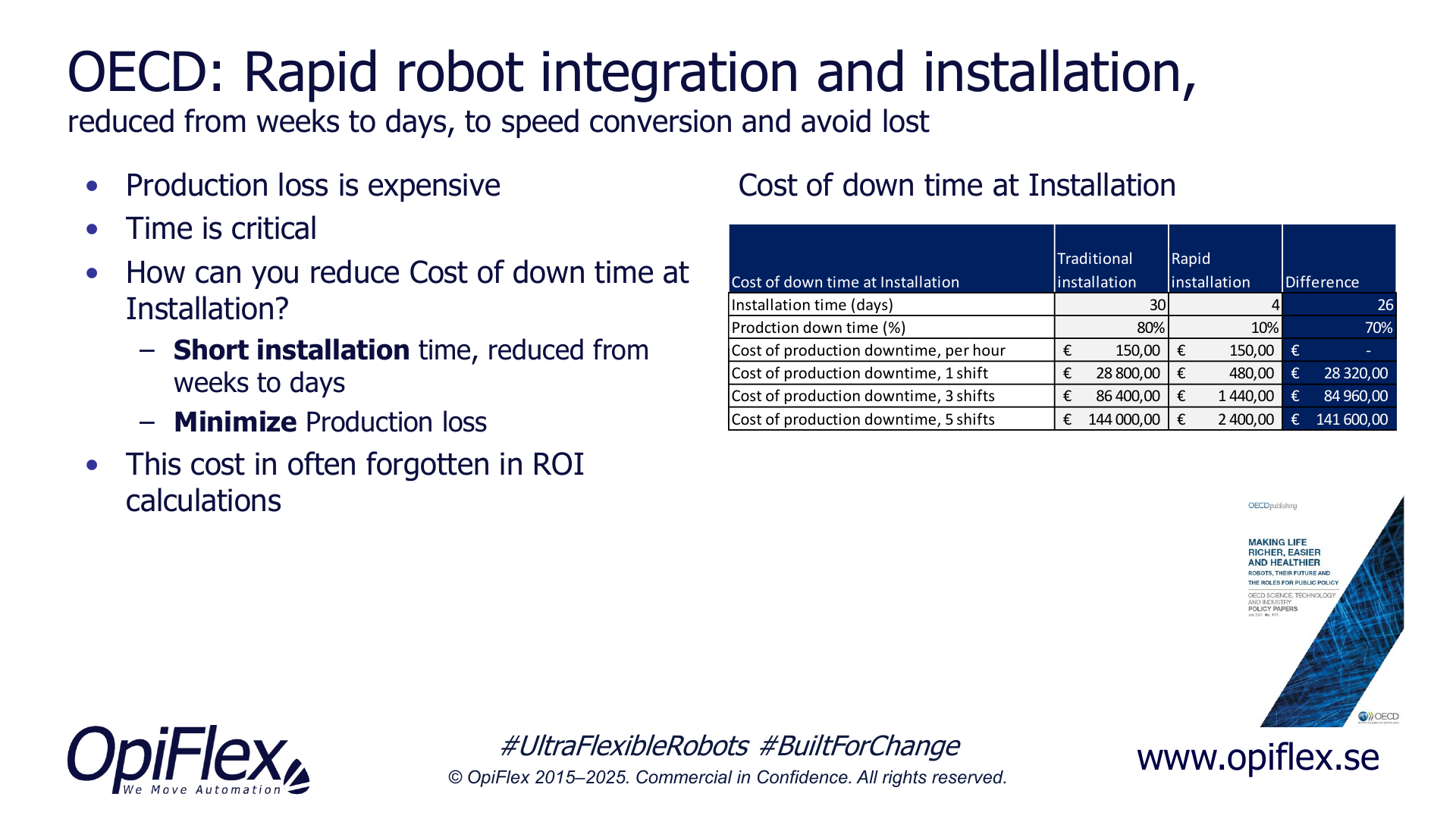
Hidden costs in a robot investment: ROI example | OpiFlex
Installation downtime, new products and weeks of waiting rarely appear in a robot investment calculation. Example calculations of what they cost per shift.
Read more