.png)
Robot programming in 1–3 minutes, no robot skills | OpiFlex
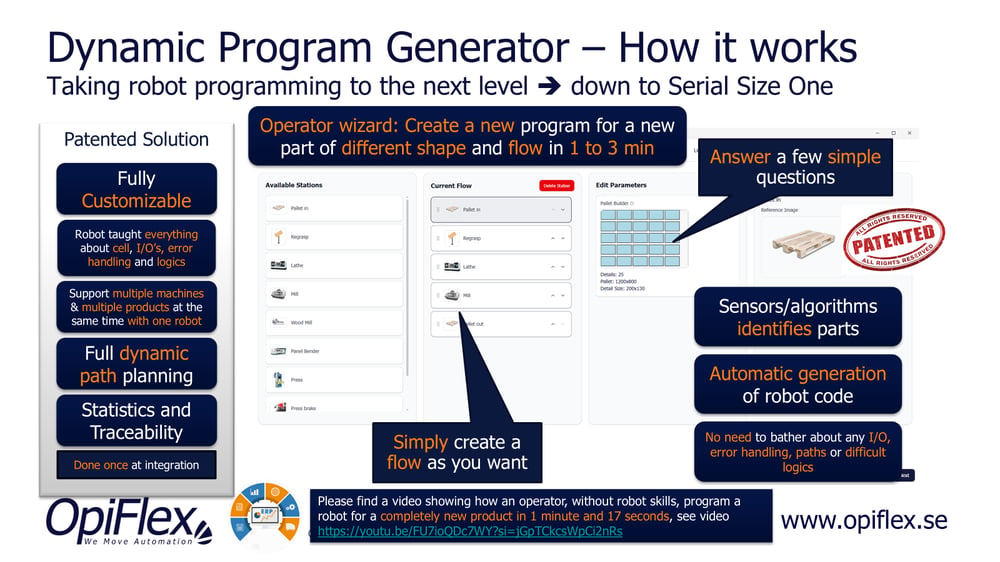
Most robot cells are programmed once and then run the same part for a long time. That works well when volumes are high and the products stay the same. When a machine runs hundreds of different parts a year, the question changes: how long does it take to add the next one?
With traditional programming, a new part typically takes 10 to 60 hours of work by a specialist. For a batch that runs for a day, that is hard to justify. So the robot stays on the long series, and the short ones are done by hand.
What is done once, at integration
With the OpiFlex Dynamic Program Generator, the work is split in two. When the cell is installed, everything that belongs to the cell is taught once: the machine, the I/O, the logic and the error handling. After that, nobody needs to touch it again to add a new part.
What the operator does
For each new part, the operator answers a few simple questions and chooses the flow through the machine. The system then generates the robot program, including the paths. It takes 1–3 minutes, and no robot programming skills are needed. The method is patented.
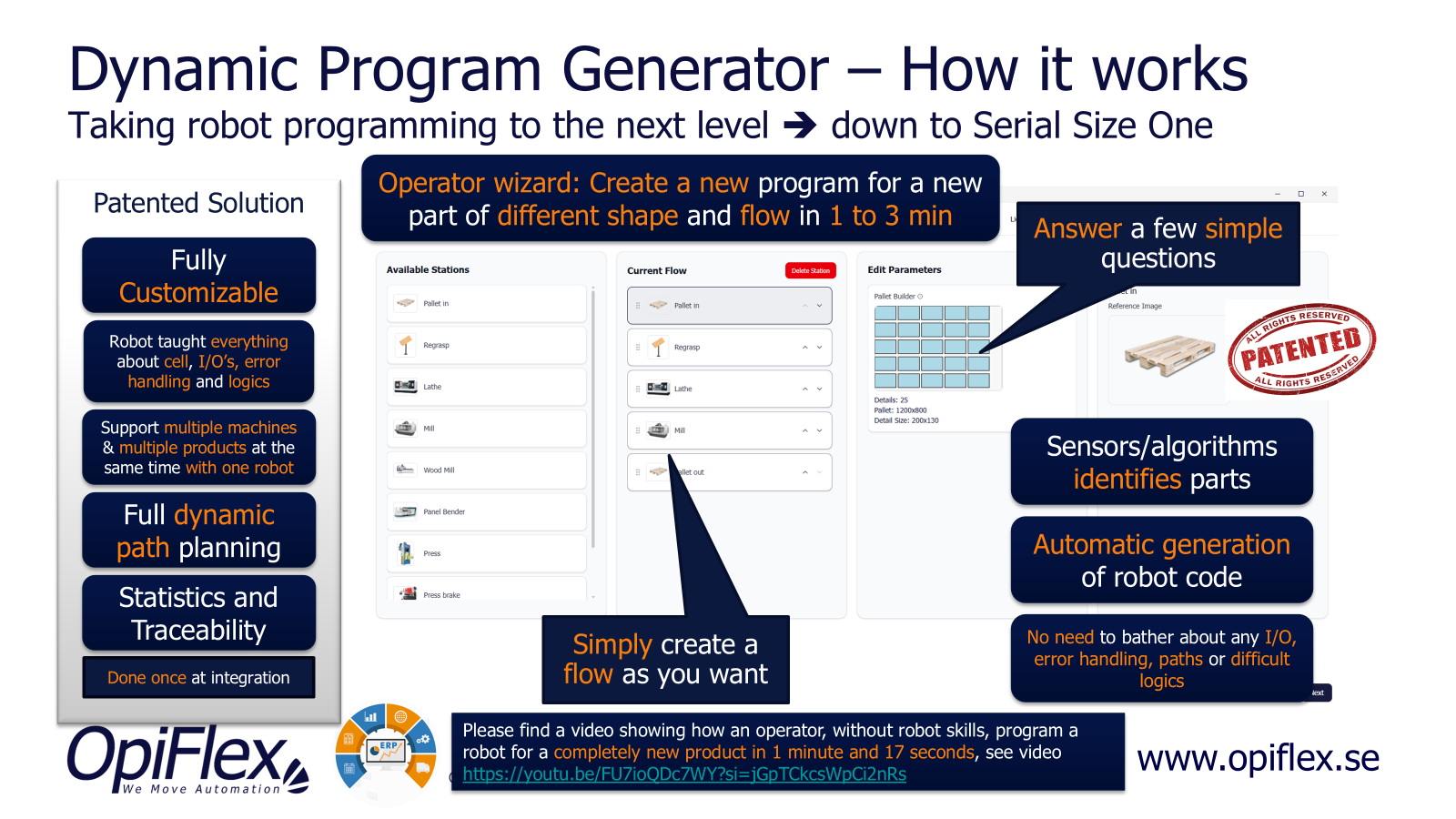
The operator picks stations for the flow, such as pallet in, lathe, mill and pallet out, and answers a few questions about the part. The robot code is generated automatically.
The programming is done offline, so the machine keeps producing while the next part is prepared. In the film below, an operator with no robot experience creates the program for a completely new product in 1 minute and 17 seconds.
Three ways to program a robot
| Traditional programming | Wizard interface | Dynamic Program Generator | |
|---|---|---|---|
| Time per new part | 10–60 hours | 1–3 hours | 1–3 minutes |
| Skills needed | Expert | Technical skills | No robot experience |
| Machine while programming | Stopped | Stopped | Free to produce |
| Profitable batch size | Large series | Medium series | Small series, even 15-minute jobs |
| Best fit | High-volume, repeat production | Repetitive, simple tasks | High mix, and high volume that changes |
Each has its place. Traditional programming is a good fit for long runs that rarely change.
What one new part costs
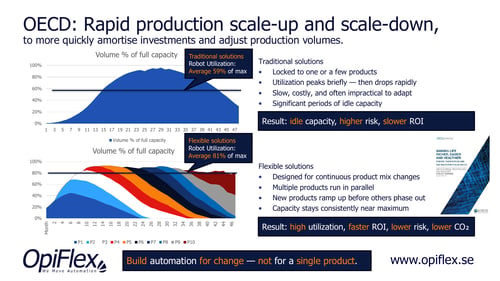
The OECD report on the future of robotics, where OpiFlex is featured, lists five needs that manufacturers share. One of them is flexible robot configurations and fast programming, to adjust production quickly to new products and to mix products on the same machine. In practice, that means adding or removing robots, machine modules and people as needed, and adding new products quickly.
What that is worth becomes clear when you count the cost of adding a single product. In our example calculation, a new part takes 60 hours of programming and online testing at a cost of €10,000. The machine is down for 80 % of that time, at €150 per hour. On one shift, adding the part then costs about €17,200. With the Dynamic Program Generator, the same part costs about €4.50, and the machine keeps producing.
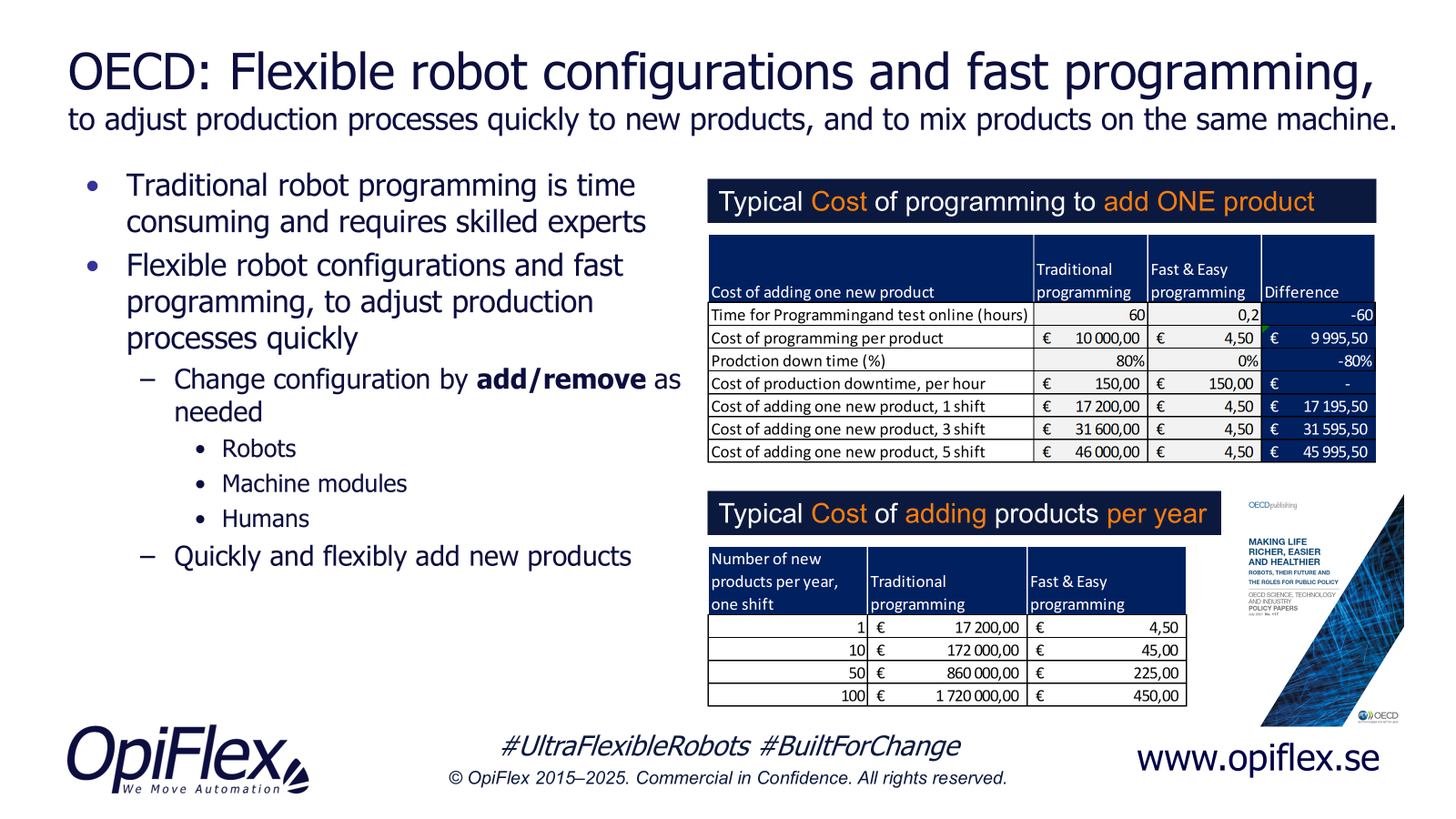
| New products per year, one shift | Traditional programming | Dynamic Program Generator |
|---|---|---|
| 1 | €17,200 | €4.50 |
| 10 | €172,000 | €45 |
| 50 | €860,000 | €225 |
| 100 | €1,720,000 | €450 |
On three shifts, one new product costs about €31,600 with traditional programming, and on five shifts about €46,000. The more new products you add each year, the more the programming time decides whether short series are worth automating.
Several products, several machines
With Dynamic Flow Optimization, the operator chooses the product flow instead of the robot sequence, for several products at once. The robot then optimises its sequence based on the cycle times it measures, and can take input from the ERP system. One robot can run one or more products through one or more machines, down to batch size one.
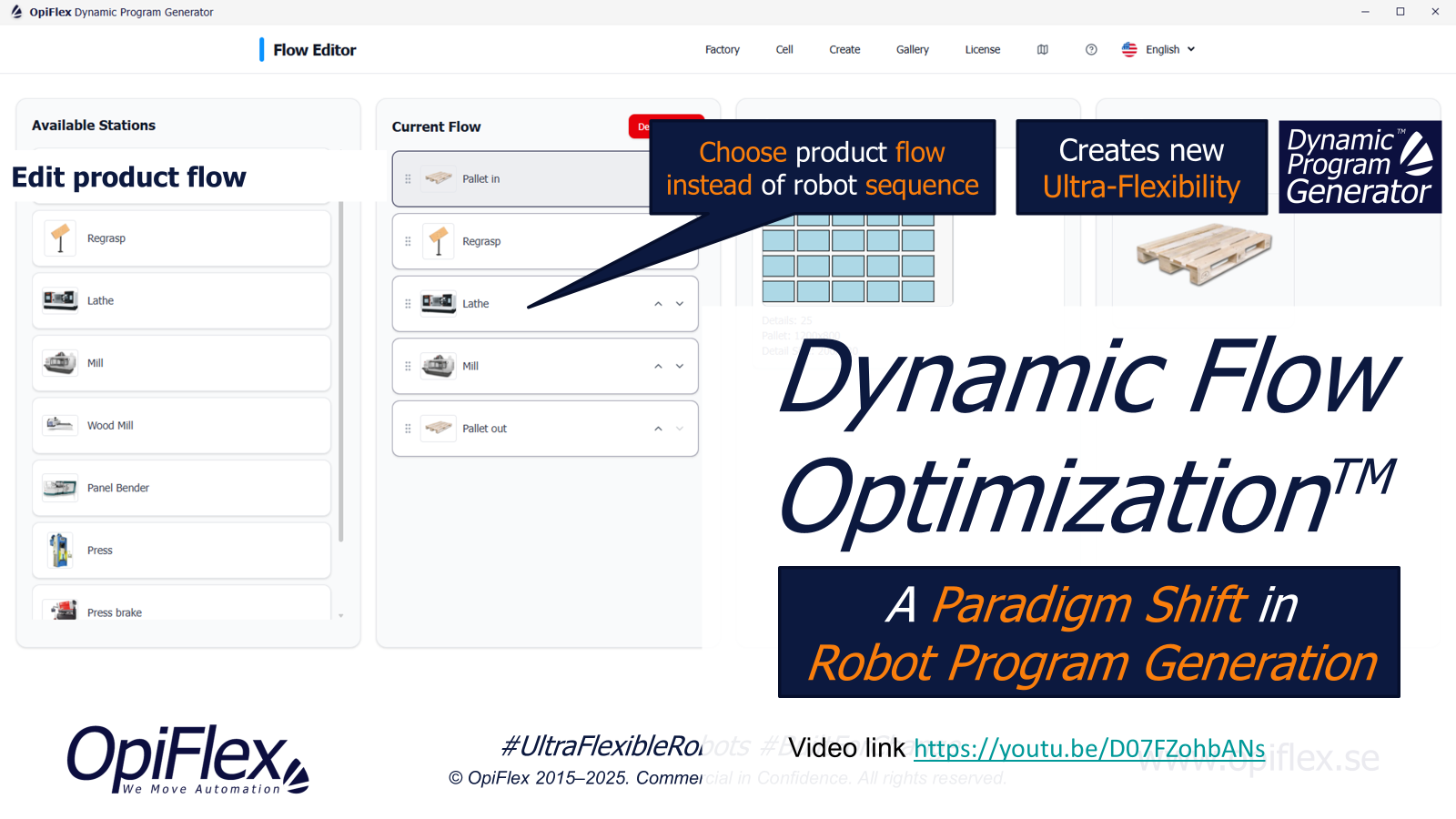
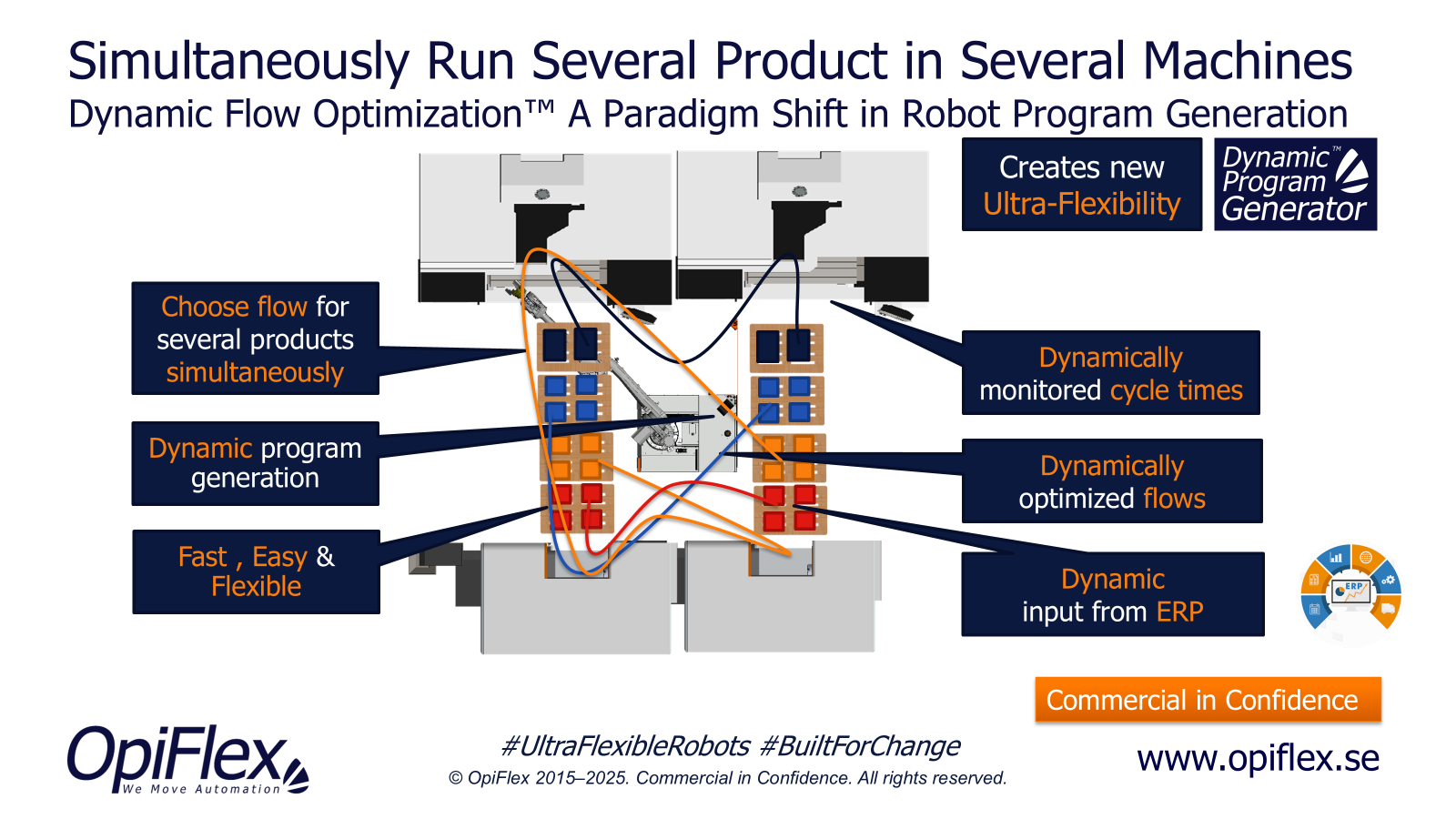
One robot, two machines, several products at the same time. The flows are optimised from monitored cycle times and input from the ERP system.
Fully deterministic, by choice
We have chosen not to use AI to create robot programs. It risks making it take longer to create a new program, and it adds risk. We run large, fast robots in production that demands reliability and robustness. One error, such as a crash or simply a stop, can be very costly.
So the Dynamic Program Generator is fully deterministic. With our patented method for creating robot programs, we solve what others try to solve with physical AI, in a fully deterministic way. We do use AI for some vision applications, with our own vision system that does not need a lot of training.
What it means for the robot technician
The robot technician sets up the cell once and is no longer the only person who can add a new part. When a new program takes minutes instead of hours, short series become worth running in the robot, including at night when nobody is in the workshop.
See it with your own parts
If you send us a few pictures of typical parts, we will go through how they would be set up in a 30-minute call on Teams. Contact us.
Related articles
-
Standardised flexible robot cells for OEM, Tier 1 | OpiFlex
More variants, new lines, 3–5 shifts. How OEMs and Tier 1 suppliers get flexible robot cells that are standardised, quick to install and easy to maintain.
Read more -
10 Years of Disruption: How OpiFlex Redefined Flexible Robotics in Manufacturing
Discover how OpiFlex transformed robot automation with ultra-flexibility and smart programming—10 years after winning the EU's top innovation award.
Read more -
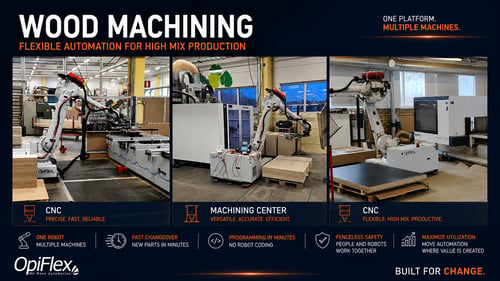
Wood industry robot: 4,000 new parts a year, 24/7 | OpiFlex
A small wood manufacturer adds 4,000 new parts per machine a year and often runs 24/7 with a mobile robot. No robot skills needed. Here is how.
Read more